
Short answer
Medford homes heat with both fuels. Oil-fired boilers are common in older houses — look for a fuel tank in the basement or outside — while gas-fired boilers connect to the gas main with no tank on site. Both need regular service, but they fail in different ways: oil systems around the burner and fuel delivery, gas systems around ignition, combustion air, and venting.
How to tell what you have
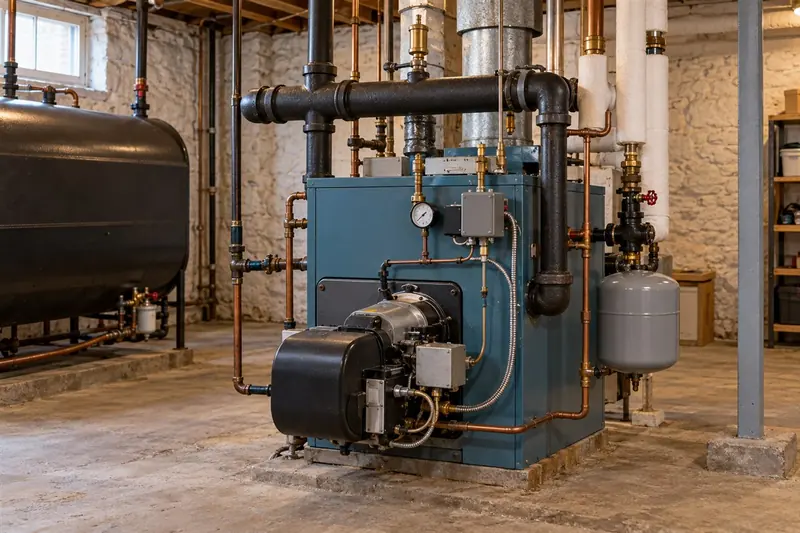
A tank is the giveaway for oil: a large steel tank in the basement, garage, or yard, plus a burner assembly with a fuel line running to the boiler. Gas boilers have a gas pipe and shutoff valve feeding the unit, a flue for exhaust, and no stored fuel. If you are unsure, the boiler's rating plate or a past service sticker usually names the fuel.
Oil-fired systems: what to know
Oil boilers pair a burner — essentially a controlled flame thrower — with a heat exchanger and, in many Medford homes, steam or hot-water distribution. They are forgiving machines that can run for decades, but the burner needs periodic attention: nozzle, electrodes, filters, and combustion setup all drift out of tune. Soot, delayed ignition, or a burner that locks out usually trace back here. Fuel quality and tank condition matter too; water or sludge in an aging tank causes no-heat calls that look like boiler faults. For the full scope, see oil and steam boiler repair in Medford.
Gas-fired systems: what to know
Gas boilers — including wall-hung combi units that also make domestic hot water — ignite on demand and modulate with the thermostat. Common trouble spots are ignition components, flame sensing, condensate handling on high-efficiency models, and venting. Because there is no tank to watch, gas problems tend to announce themselves as lockouts, fault codes, or intermittent firing rather than a slow decline. See gas and combi boiler repair in Medford for how these are diagnosed.
Steam versus hot water matters more than fuel
Whatever the fuel, the distribution decides much of the service story. One-pipe steam systems need correct venting and near-boiler piping; hot-water systems need healthy circulation — pumps, zone valves, and balanced emitters. Many Medford houses pair an older distribution system with a newer boiler, which is why diagnosis starts with the whole system, not just the burner.
Maintenance differences
Oil burners want annual combustion-side service: cleaning, nozzle and filter replacement, and combustion checks. Gas boilers want ignition and safety-control checks, condensate trap clearing where fitted, and vent inspection. Both benefit from the hydronic side being serviced too — pressure, expansion, and water quality. Boiler maintenance and power flushing covers what a visit typically includes.
Questions to ask before approving work
Ask the provider to confirm the fuel and distribution type before quoting — "boiler repair" means different things on oil-steam versus gas-hot-water. Ask what is burner-side versus system-side in their diagnosis. And if anyone recommends replacing the boiler, ask what is wrong with the current one that repair cannot address; fuel type alone is rarely the reason.
Related service pages
For fuel-specific help, see oil and steam boiler repair in Medford and gas and combi boiler repair in Medford. For upkeep, review boiler maintenance and power flushing, and request service when you are ready to describe the issue.